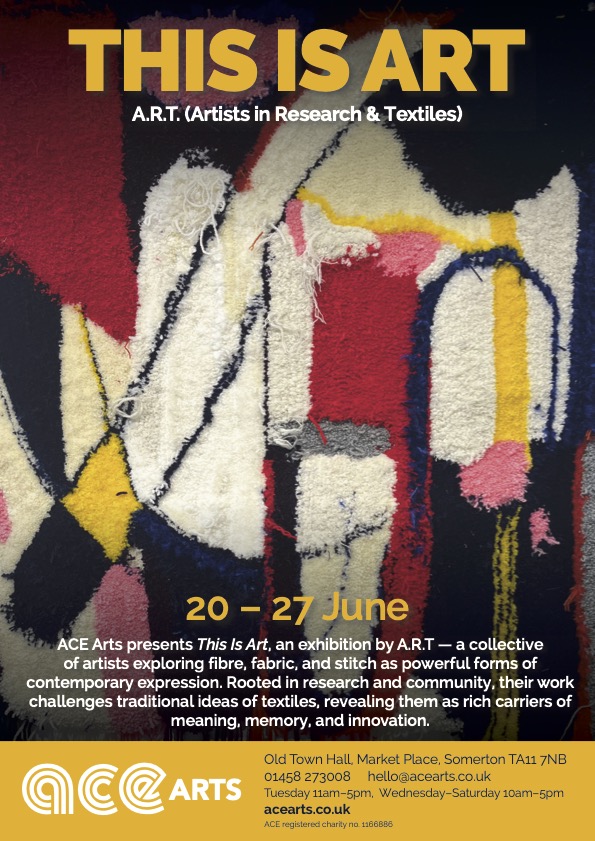

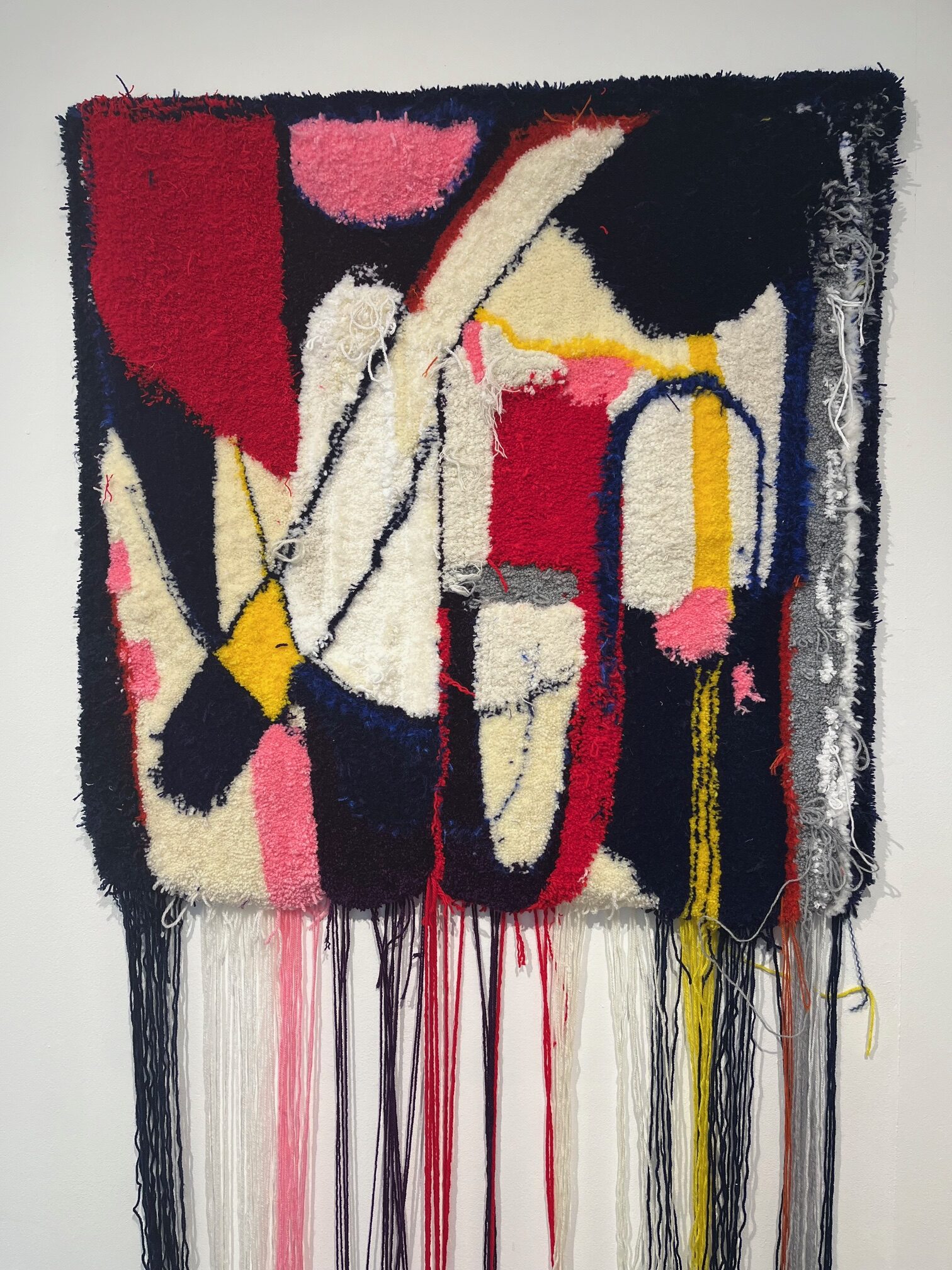
A.R.T
A.R.T. – Artists in Research and Textiles
A.R.T is a collective of artists and makers who explore fibre, fabric and stitch as mediums for artistic expression and enquiry.
Rooted in the belief that textiles are more than craft– they are carriers of meaning, memory and innovation – A.R.T provides a space for creative dialogue, skill-sharing and mutual support. We welcome artists at all stages of their journey who use textile processes in their practice, whether through traditional handiwork, experimental techniques, or conceptual approaches.
Grounded in community and inspired by the rich legacy of fibre arts, A.R.T is a place to connect, research, challenge, and grow- together.’
FUTURE EXHIBITION(S):
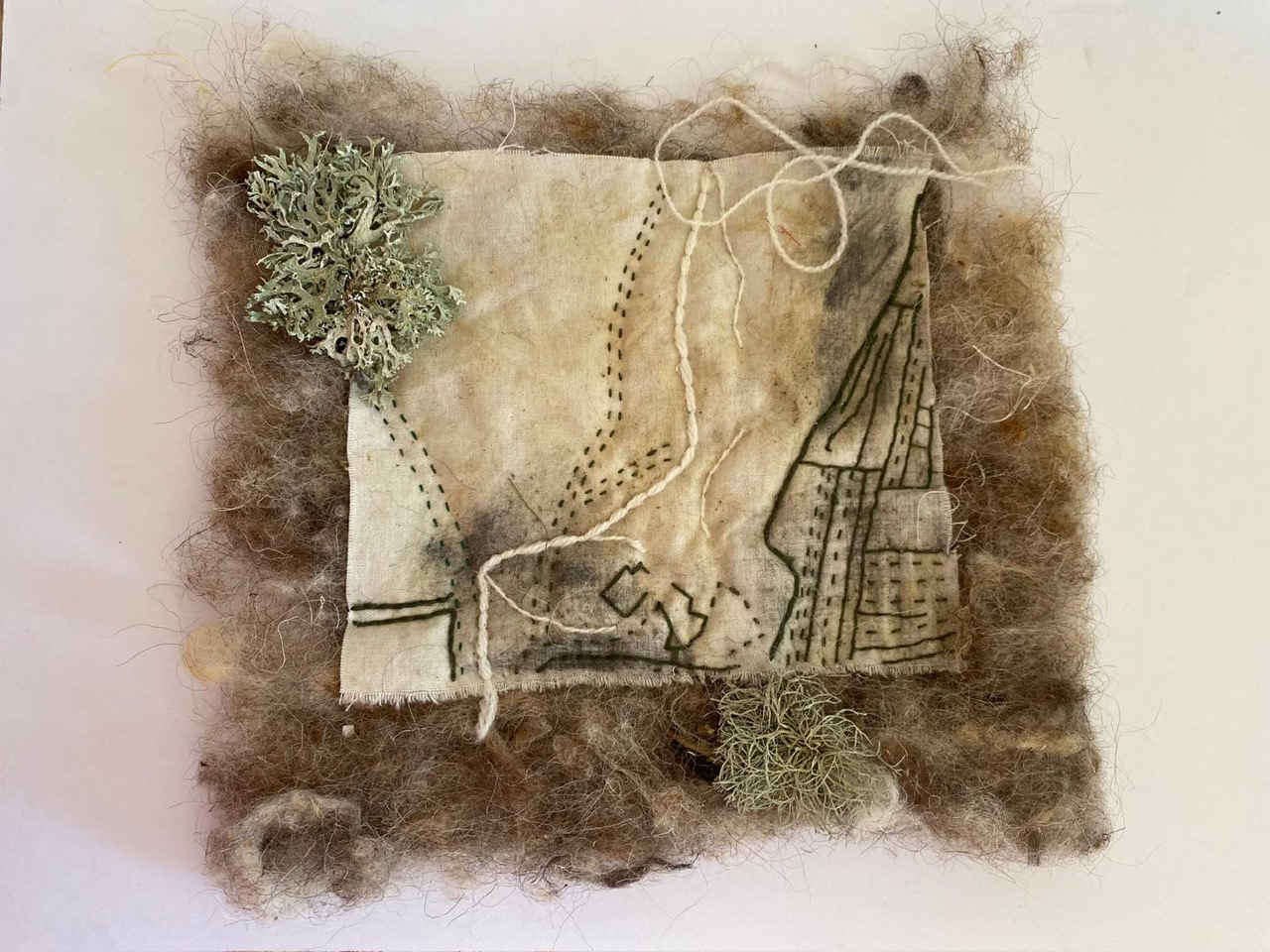
Stitch, Stone and Soil:
Contemporary responses to an ancient landscape.
This exhibition presents new work by A.R.T a collective exploring place, material, and process through contemporary textile practice. The exhibition features work inspired by Ham Hill, the largest hillfort in the UK, responding to its landscape, history, geology, nature, and wildlife.
Developed through research, making, and site engagement, the works reflect on Ham Hill as both a historic site and a living ecosystem, interpreted through textiles and mixed media.
The exhibition will take place in the new Visitor Centre Gallery at Ham Hill, near Yeovil, from 19 September to 25 October.
The Artists in this circle are:
Alice Bowen
Alice Crane
Surrounded by stitchers, makers and painters as a child, Alice Crane’s practice has evolved through both craft and fine art disciplines, and Fine Art Textiles became a natural path of study. A painter at heart and a self-confessed hoarder of memories, stories and scraps, Alice recycles found objects, textiles and paper, re-using treasured scraps, bound together with stitch: a loved one’s shirt, discarded paintings or paperwork become immortalised within layered, abstracted landscapes. Making work for me is paying homage: a way of capturing and celebrating the domestic and natural environment that is ‘home’.
@alicecraneartist http://somersetartworks.org.uk/artists/acrane/ http://bhaam.org.uk
Angela Knapp
I am a textile artist based in Somerset. I create hand-embroidered studies of British birds; these are often stitched onto vintage papers, maps, and archival documents. My work explores the impact of species decline and our changing relationship with the natural world.
Growing up in the 1970s, I witnessed a dramatic transformation of the landscape, with many once-familiar species suffering significant declines. My work serves as both a celebration of their beauty and a highlight of their vulnerability; I invite viewers to consider what is being lost from our natural world and the role we all play in its future.
@angelaknapp2textileartist www.angelaknapp.co.uk
Janina Bacchetta
My name is Janina Bacchetta, and I am a Welsh Black female Textile Artist. I am interested in using cloth as a means to narrate my own stories and the lived experiences of others. I am conscious of the responsibility that creatives have in what they contribute to the world. I draw upon the values that are imperative to my creative practice. I look for the joy in what I create and the possibility to entice positive social and cultural change. Authenticity is at the heart of my practice.
Taking inspiration from photographs, I create conceptual portraiture quilts that carry material meaning, encapsulating my subjects’ character and emotion. To do this, I use hand embroidery, appliqué and natural dye techniques, which express my need to create work that uses traditional processes in new and subversive ways. The familiar remains an integral aspect of my creative process, where the domestic theme is the foundation and an inspirational method that I have embraced.
@janina.bacchetta
Sue Green
I am continually drawn to the narratives that emerge through the slow unpicking of used cloth and clothing. Prolonged and intimate engagement with material allows space for imagination, evoking memory and generating partial narratives in which hidden details surface. As hems unravel and seams are released, traces of the original maker are revealed skilled hands, labour, and unknown lives. Every inch then passes through my own hands, leaving subtle traces within the fibres and contributing to a material lineage shaped by past and present. Through processes of deconstruction and unmaking, deeper connections and new iterations emerge.
@sue_green_art http://somersetartworks.org.uk/artists/sue-green/ http://textilesstudygroup.co.uk/members/sue-green/
Helen MacRichie
I explore my personal connections with the landscape and natural world through my creative practice. Coming from an academic background in pharmacy, I often draw inspiration from scientific and medicinal subjects, informing both my concepts and materials.
Wet felting with wool plays a significant role in my work through the connection of wool to land and place, and the tactile transformation experienced firsthand in turning fibre to fabric. Free machine embroidery adds further texture and layered detail, supporting the design narrative. I am particularly drawn to the versatility of felted wool, allowing me to create pieces with dimension and/or transparency.
www.helenmacritchiedesigns.com @helenmacritchie
Charlotte Humpston
I trained as a theatre designer in London & co-founded Red Shift Theatre Co., winning 3 Fringe First Awards for set & costume design. Moving to Somerset, I became a landscape painter inspired by the Mendips & Somerset Levels. I went on to train & work as a textile teacher, creating textile projects including GCSE & A-Level studies. In 2016, I received my Master of Fine Arts from Bath Spa University. I developed my ideas using felt-making techniques with the use of recycled clothes, threads, & fibres. In 2025, I completed a course in the Japanese technique of combining natural pigments & soy milk (used as a binder), which is painted onto linen.
https://www.charlottehumpston.com/@charlottehumpston
Kelly Harris
My art practice is driven by experimentation and an in-depth investigation of materials and processes. I work primarily with textiles, fibres and textile processes – testing, pushing, and reworking materials and/or processes beyond their intended or traditional uses. I engage with what already exists rather than new resources, preferring to work with discarded, found and repurposed materials. Through playful and rigorous experimentation, I investigate how materials respond to manipulation, alteration and the process of breaking down and re-processing. I develop work in ways that are exploratory, innovative and unique.
It is through my art practice that I learn about and understand the world I live in.
@k.e.l.l.y.h.a.r.r.i.s
Jan Ollis
Jan Ollis is a Somerset-based textile artist whose work often uses stitched words, print and mixed media to explore landscape, memory and local history. Inspired by the natural environment and a strong sense of place, through layered surfaces, hand stitching and printed text, her work reflects an interest in storytelling, sustainability and the histories carried within everyday materials. Her practice invites viewers to connect with the quiet narratives embedded within the landscape.
@janollisart Janollis.co.uk
Jane Coloquhoun
I have been patching, mending and making with scraps since childhood. Like many female stitchers, textile art became a means of maintaining a creative practice in the home alongside my busy working life as an artist and arts educator. Working from miscellaneous fragments, I create collections that blur autobiography and fiction. Arrays of figures evoke a community of myself and others. Textile motifs, flowers, seeds, feathers, text, transform them into bizarre hybrid flower maidens, mermaids, dancing queens, or grumpy goddesses. Often playful and comical, these characters balance humour with reflection, exploring belonging, identity, family histories, and connection through stitched personal archives.
@jane_colquhoun https://Janecolquhoun.com
Joy Merron
Work statement: Earth skins
Earth is a complex and layered living entity represented here by layers of stitched organisms on wool felt. Healthy soil is an essential part of the planet’s ecosystem for growing plants and animals for food and clothing. Materials have been harvested from the earth, so let’s keep them in circulation for as long as possible.
@joymerron
Anna Konig
Working primarily with paper and cotton yarn, König creates richly textured abstract works through the slow and meditative practice of hand stitching. Each piece evolves over weeks and months, layering spontaneous responses in thread over earlier colour collages — some created decades ago — which remain hidden beneath the surface of the final work.
Guided by the colours and shapes of these underlying compositions, König’s stitching develops intuitively into vibrant fields of rhythm, texture, and movement. Functional embroidery techniques such as blanket stitch and herringbone stitch are transformed into dynamic visual structures, creating boundaries and holding spaces for colour while generating densely detailed surfaces that seem to pulse with energy.
Describing her process as “akin to a jigsaw puzzle”, König explains that a work is “only finished when each stitch is in place.” The resulting pieces invite viewers to become immersed in abstract detail and colour, echoing the focused, contemplative experience of their making.
@adkonig
Lydia Needle
Mostly, I stitch,
On to old materials,
Or mend old materials
With old threads
Cast offs.
Sometimes I bury my work with food waste for the compost worms to see how long it takes them to lock the carbon in.
To create worm casting with it.
Cast-offs.
Sometimes, I leave my work in the rain, or the sun, or hide it under plants whilst out walking, running.
Sometimes the work is left for the slugs and snails – I love seeing what happens, how they chomp it down, leave teeth marks, as good detritivores do.
Am I a textile artist?
@lydianeedle www.lydianeedle.com
Leah Hislop
Leah uses materials and mediums often associated with the craft movement, and frequently uses materials such as textiles and paper. She takes methods that are typically used for smaller works and creates larger, site-specific pieces. Her installations explore art that is transient and short-lived, like the seasons and patterns of nature. Most of her works are built on site, and for this reason, they fit into their natural surroundings and are interactive to the viewer.
@leahhislopart
Lou Baker
It’s a question of balance. The darker side of Lou Baker’s sculptural practice is balanced by a brighter side of social engagement as she makes public things that are normally private. She’s a maker, a facilitator and a performer. Sensory, immersive and often participatory, her work provokes a range of conflicting responses.
Stereotypically, hand-knitting is functional, perfect and finished, connected with garments, domesticity, comfort and the body. Baker’s knitting subverts these expectations. It’s sculptural, sloppy craft; unfinished, unravelling. Site-responsive, it’s shapeshifting, formless and flexible; alluring, yet somehow, also, uncanny. Its soft impermanence and associated femininities remind us of our mortality.
@loubakerartist www.loubakerartist.co.uk
Emma Mawston
Emma moved to Somerset in 2023 after 35 years working as a designer in London. Winning an RSA Bursary during a degree concentrating on craft-based work led to a period of more commercial print design; working for John Lewis, Nigel French and then Liberty, where she worked for 24 years, with 18 as head of design for fashion and then interior fabrics. She now works for Will Bees Bespoke where her involvement with designing for pollinator planting and protection began. She is in the process of launching Women & Bees, an Environmental Art Movement with two colleagues. Emma also has exhibitions of her work, hoping to exhibit next year an exhibition called ‘Going Shopping’ inspired by shopping locally.
@emmamawstondesignercollective
Oly Bliss
Oliver Bliss is a textiles artist who enjoys exploring themes of identity, sexuality, and gender. He lives in Worcester with his partner Craig and two cats Arti and Otto. Works by Oly Bliss emerge from an evolving exploration of composition and colour, where discarded materials are reimagined and transformed. Fragments once overlooked are brought into dialogue, forming new visual relationships. Through this process, Bliss investigates balance, texture, and renewal, allowing each piece to carry past and redefined presence.
@olybliss
Pen O’Gara
My heart lies with the land & how we build a meaningful relationship with it. Combining history & folklore with materials & processes that respect the environment, my work is an exploration of this path. Using natural fibres, found objects & dye-stuffs foraged from my garden I create figures with a strong sense of place, & a narrative that draws the viewer into their world. Glimpses of the magic in my corner of the world to inspire a fresh look at our surroundings, the stories that inspire us to cherish the land, to care for & defend the planet.
Tracey Baker
Rachel Cole
Rachel is a lifelong creative who finally allowed herself time to complete her Art Foundation in 2025 as a mature student. Achieving a Distinction and receiving the Fine Art 3D Award 2025. Proving that it is never too late to turn the page and start a new chapter. She has since shown work at the Bath Open Art Prize 2025. Her work is varied, but to date always involves matters of the heart or of a political stance. She focuses her attention on the use of repurposed materials, so as to tread lightly on the earth whilst following her creative passions.
Vivienne Beaumont
I have found my artistic identity using symbolism, cloth and thread. The ephemerality and cyclical nature of life are at the core of my textile practice. I use archetypal imagery to convey collective emotions, referencing the figurative, the mythological, nature, and the theme of transformation. Harvest, seeds and pomegranates represent both life force and loss. I like to explore the commonality between us and also the cultural collective memory.
@vivienne.beaumont https://www.viviennebeaumont.co.uk
Nina Gronw-Lewis
Nina is an artist based in Somerset, working primarily with textiles, paper and reclaimed materials. Her practice is rooted in a lifelong relationship with making, shaped by family traditions of sewing, knitting and resourcefulness. She explores ideas of memory, attention and value through thread, yarn and textile processes. Traditional textile techniques and reclaimed materials are central to her work, reflecting a commitment to thoughtful making and environmental responsibility. Through slow, tactile processes, Nina invites viewers to reconsider the value of making, memory and our relationship with the everyday.
@ninagronwlewis www.ninagronw-lewis.co.uk
PAST EXHIBITIONS: